The Boy Who Cried Wolf, and the Brands AI No Longer Believes
Why AI answer engines like ChatGPT, Perplexity, and Gemini trust corroborated evidence over confident claims, and what that means for how brands build credibility.
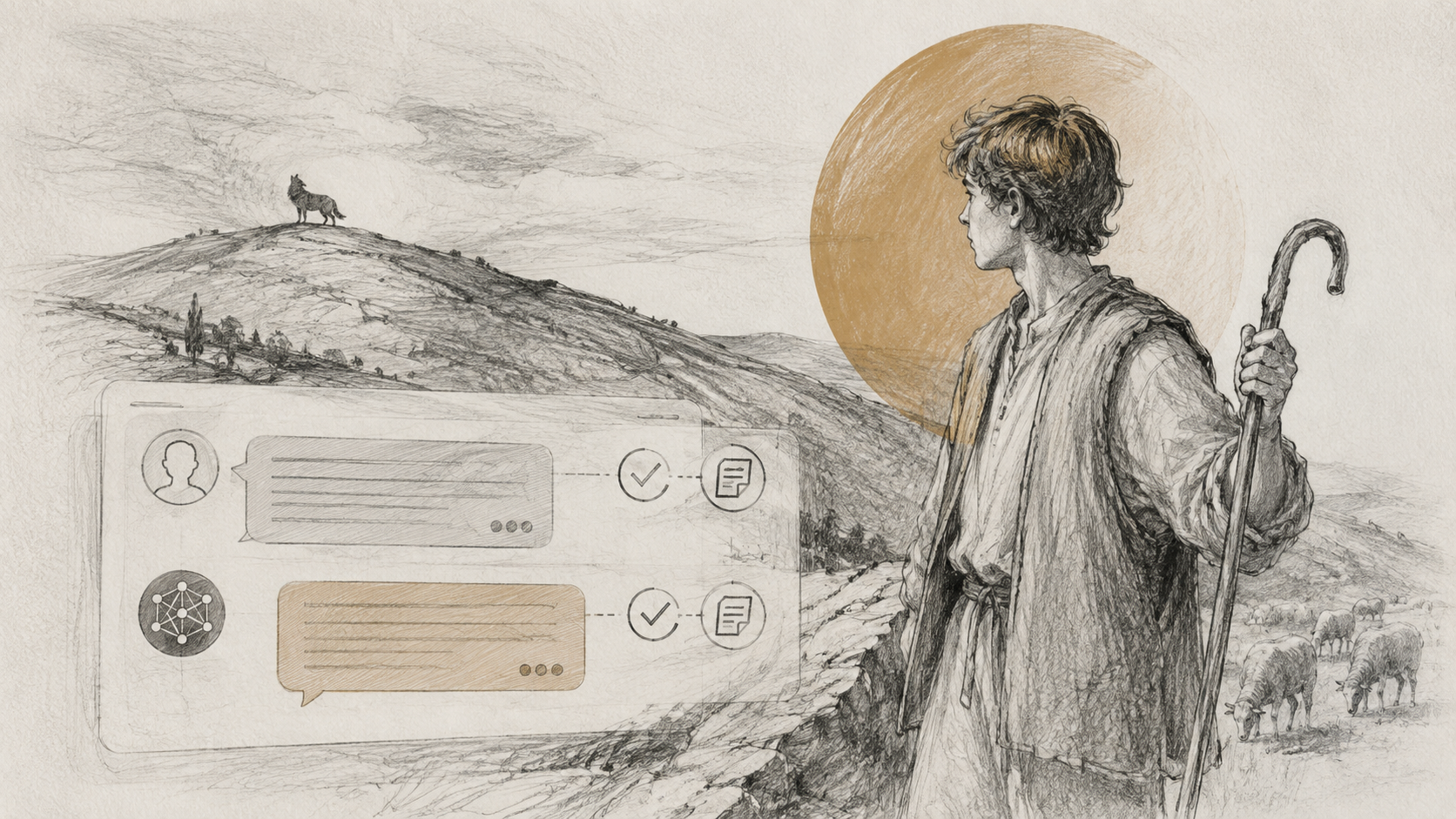
Aesop's fable: A shepherd boy repeatedly tricked his village into believing a wolf was attacking his flock. When a real wolf finally came, no one believed him, and the flock was lost. The old moral: Credibility, once spent, is expensive to rebuild.
Here's the new one: AI systems are now the village. And most brands are still the boy.
TL;DR
AI answer engines don't ask "what does this company say about itself?" They ask "does the rest of the internet agree?"
A confident claim on a homepage is one data point.
A claim backed by documentation, independent coverage, structured data, and consistent third-party mentions is corroborated evidence.
Language models are built to weigh the second far more heavily than the first, and that single distinction is quietly rewriting what marketing has to be good at.
Confidence used to be enough. Now it's the tell.
For twenty-five years, digital marketing rewarded volume: more pages, more keywords, more backlinks, more superlatives in the hero section. Search engines got progressively better at discounting pure noise, and generative AI has taken that several steps further. It doesn't rank pages. It synthesizes an answer from many sources at once, and a homepage claiming to be "the world's leading platform" is just one voice in that synthesis, competing against documentation, review sites, technical benchmarks, and whatever independent parties have actually said about you.
This is the part that trips people up: you can say the true thing, clearly and often, and still not be believed, if nothing else on the internet is saying it with you. Not because the model is being unfair. Because a single, self-interested source is exactly the pattern a system trained to detect unreliable claims is built to discount.
Two companies, same claim, different outcome
Picture two infrastructure startups making an identical claim: fastest deployment in their category.
The first has that line on its homepage and nowhere else. No benchmark data, no third-party writeup, no changelog showing the work, no customer quote you could verify. It's a strong sentence sitting alone.
The second has the same line, but it's also sitting inside a public benchmark report, referenced in a developer's comparison post, described consistently across its docs and its Crunchbase listing, and backed by a case study naming a real customer outcome.
Both companies are, let's say, telling the truth. Only one of them is checkable. And checkable is what gets cited.
Why this is a bigger shift than it sounds like
Traditional SEO answered one question: can people find you? Generative search is answering a stack of harder ones, and each layer filters out more companies than the last.
Being retrieved isn't the same as being cited. Being cited isn't the same as being recommended. A page can rank first on Google and never make it into an AI-generated answer to the exact same question, because ranking and retrieval run on different logic entirely. A 2026 study analyzing 11,500 queries found that ChatGPT showed close to zero overlap with Google's own top-10 results, while Perplexity overlapped at roughly 14% and Gemini at roughly 8.5%. These systems are effectively reading different slices of the same internet and reaching different conclusions about who's credible.
What they do largely agree on is the type of evidence that earns trust. Yext's analysis of 17.2 million AI citations across ChatGPT, Perplexity, Gemini, and Claude found that verified, structured, directly distributed data accounted for over half of all citation sources, more than any other single category. The format changes by platform. The underlying demand for corroboration doesn't.
This isn't a marginal shift, either. Gartner has forecast that traditional search volume will decline by roughly 25% as generative AI becomes more central to how people find information, and early data on the traffic that does arrive from AI answers shows it converting at meaningfully higher rates than a typical search click. The audience is already moving. The evidence bar is what decides who they find when they get there.
What "not crying wolf" actually looks like in practice
This isn't an argument for saying less. It's an argument for saying it in a way that can be checked:
- Documentation that a model can actually extract from. Clear, structured, unambiguous, not marketing copy dressed up as docs.
- Structured data and consistent entity information, so your name, description, and claims read identically wherever a system encounters them—your site, your listings, your knowledge panel.
- Independent corroboration, benchmark studies, analyst mentions, developer discussion, press that didn't originate from your own press release.
- A visible, verifiable track record, case studies with names attached where possible, real numbers, dated evidence rather than evergreen claims that never update.
None of this is exotic. It's closer to what serious PR and analyst relations have always done well, just aimed at a new set of readers who happen to be machines cross-referencing everything at once, instantly, every time someone asks a question in your category.
The moral of the story
The shepherd boy didn't lose the flock because no one could hear him. Everyone in the village had heard him plenty of times. He lost it because he'd spent his credibility before the moment that actually mattered.
That's the trap waiting for brands that optimize for being loud instead of being verifiable. Visibility gets you heard. Corroboration is what gets you believed. And in a world where the thing standing between a customer and a decision is increasingly an AI weighing whether your claim holds up against everything else it can find, believed is the only version of visible that's worth anything.
Frequently Asked Questions
What's the difference between AEO and GEO?
Answer Engine Optimization (AEO) is the discipline of structuring content so it can be extracted cleanly into AI-generated answers. Generative Engine Optimization (GEO) is the broader practice of building the credibility and evidence signals, documentation, structured data, independent corroboration, that make an AI model choose to recommend you in the first place. In practice, the two overlap heavily and are usually pursued together.
Does this replace traditional SEO?
No. Foundational SEO work, clear structure, genuine expertise, technical hygiene, tends to help AI visibility too. GEO adds a layer on top: entity consistency, third-party corroboration, and content built to be checked and cited, not just ranked.
How would a company know if AI already trusts it or not?
The only reliable way is to ask the models directly, the same questions a prospective customer would, and see whether your brand shows up, how it's framed, and who gets named instead. That diagnostic is the starting point AISOP runs for free, before any of the rest of this matters.